NEPSE Reinsurance scandal has recently emerged as one of the most significant and complex financial scandals in Nepal’s corporate history. It involves explosive allegations of uncollateralized credit trading, artificial stock price inflation, and the misuse of billions of rupees to manipulate the shares of the nation’s top reinsurance companies.
Table of Contents
What is the NEPSE Reinsurance Controversy?
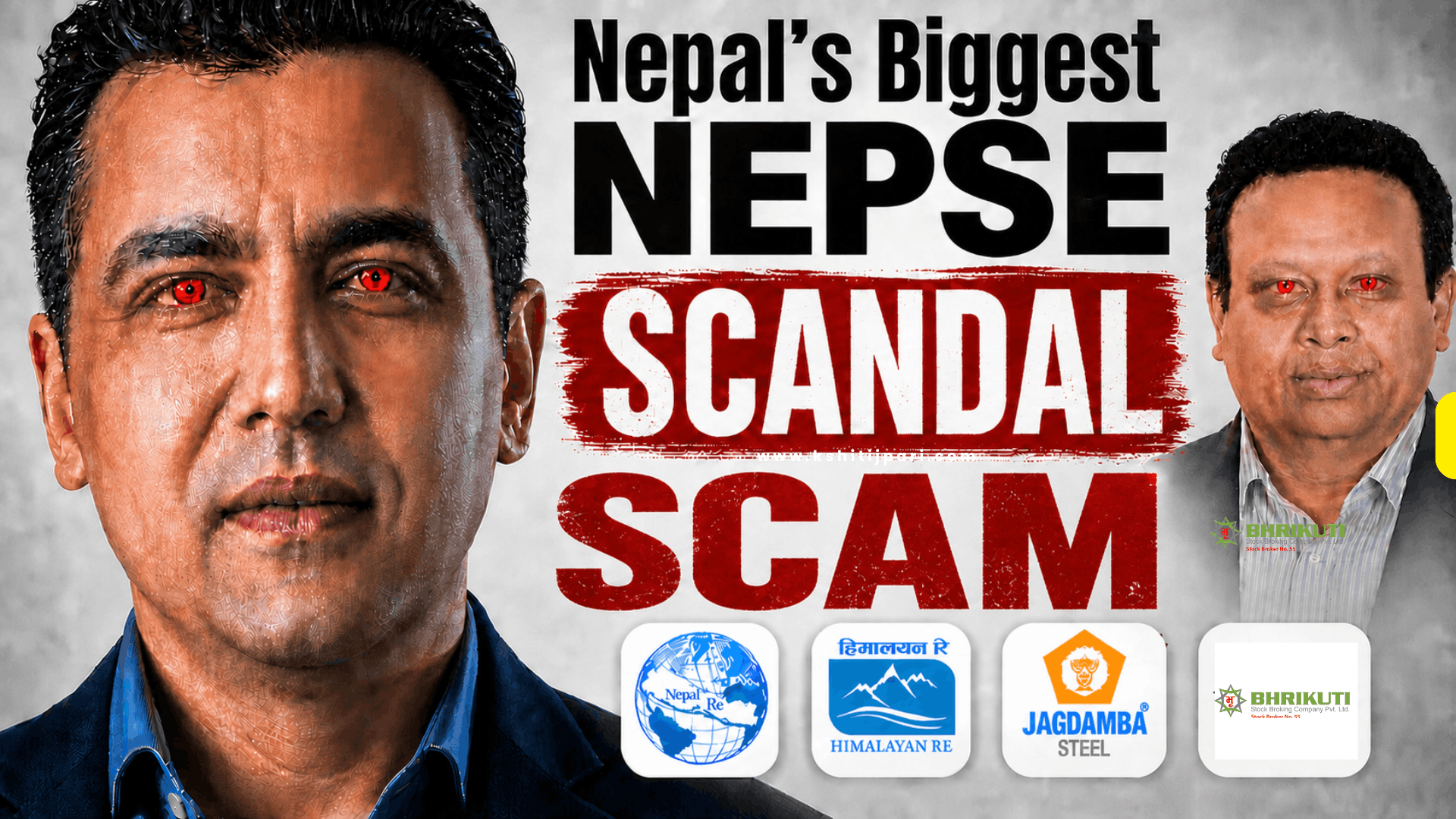
The Nepal Stock Exchange (NEPSE) is currently navigating a major legal and financial controversy following allegations of a coordinated stock manipulation scheme. At the center of the ongoing investigation are Himalayan Reinsurance Limited (HRL), a private-sector reinsurer, and its competitor, Nepal Reinsurance Company (NRIC).
Investigations claim that retail investors were influenced by an artificial price surge in NRIC shares. Authorities allege this surge was driven by NPR 3.8 billion in uncollateralized, credit-based share purchases routed through Broker 55 (Bhrikuti Stock Broking Company). Prosecutors argue that the price inflation was orchestrated by connected parties, notably Dipak Bhatta and Sulabh Agrawal, using funds with unexplained origins.
This is one of the most extensive corporate probes in Nepal’s history, resulting in four separate cases filed across three courts (Special Court, Patan High Court, and Kathmandu District Court) covering securities fraud, insurance fraud, money laundering, and banking offenses, with combined damage claims reaching NPR 27.8 billion. Because this case is currently in court, these claims remain allegations awaiting final judicial verdicts.
The Alleged Mechanism of Manipulation
The core of the prosecution’s case rests on the accusation that connected groups created artificial “Fear Of Missing Out” (FOMO) among retail investors by fabricating high trading volumes and demand.
| Investigation Aspect | Details of the Allegations |
| Suspicious Fund Flow | Authorities flagged approximately NPR 450 million transferred from Jagadamba Steels to Dipak Bhatt’s personal account without a clear business justification. |
| Connected Party Routing | Promoters linked to HRL allegedly funneled money through personal accounts, investment firms, and brokers to purchase NRIC shares silently. |
| Uncollateralized Trading | Broker 55 is accused of executing NPR 3.8 billion in NRIC purchases without advance payment from the buyers. Investigators allege the broker funded this by illegally withholding cash from the sale of HRL’s own shares, using HRL’s money to secretly buy NRIC shares for Bhatta’s group. The outstanding payments reportedly reached NPR 2.89 billion. |
| Market Impact | Driven by this allegedly artificial demand, NRIC’s share price spiked from NPR 1,461 to NPR 1,686 in five weeks before correcting. |
Timeline of the Ongoing Reinsurance Scam
- 2021: Initial Red Flags Nepal Rastra Bank’s Financial Intelligence Unit (FIU) initially flagged suspicious money movements related to the individuals involved, but no immediate action was taken.
- Mid-2025 to Early 2026 (Shrawan 5 – Chaitra 1, 2082 BS): Alleged Credit Accumulation Broker 55 reportedly executed NPR 3.8 billion worth of share purchases on credit, bypassing mandatory advance payment rules.
- April 26, 2026: Scandal Goes Public The investigation became public knowledge. Key individuals, including Dipak Bhatt and Sulabh Agrawal, were arrested to face inquiries.
- Mid-2026 Onward: Legal Action & Market Reaction Authorities filed multiple cases alleging securities fraud, money laundering, and banking offenses. Share prices of NRIC and HRL dropped significantly, and Broker #55’s license was suspended pending review.
Systemic Vulnerabilities Highlighted by the Investigation
The scale of the alleged activities has sparked a debate about the effectiveness of Nepal‘s market regulators. Analysts point to several systemic vulnerabilities that this case has exposed:
- Follow-Up on FIU Warnings: The delayed response to the 2021 red flags allowed the situation to escalate until it impacted the broader market in 2026.
- Broker Oversight: The allegations suggest Broker #55 operated without enforcing basic advance-payment rules, acting similarly to a bank offering unlimited overdrafts.
- Sector Governance: Reinsurance companies hold public trust funds for insurance claims. The case highlights the need for stricter transparency regarding the investment routes of these entities.
- Real-Time Monitoring: Regulators have been criticized for lacking real-time alerts that could identify and halt concentrated, repeated large trades by a single broker.
Critical Lessons for Stock Market Investors
Regardless of the final court rulings, this controversy offers vital risk-management lessons for retail investors navigating volatile markets:
- Do Not Chase Price Alone: A rising stock price is not absolute proof of a healthy company. Always verify if business fundamentals and profit growth justify the surge.
- Scrutinize High Volumes: Concentrated bulk buying from a single broker may signal coordinated accumulation rather than organic public demand.
- Reputation is Not a Guarantee: Prominent business houses and political connections do not eliminate risk. Clean governance and regulatory compliance are more critical.
- Beware of Rights Share Rumors: Speculating on unconfirmed rights shares often leads to traps; actual rights issues can dilute your existing holdings.
- Exercise Caution During Investigations: If a company or its promoters face serious legal inquiries, it is prudent to manage your exposure until the situation is resolved.
Frequently Asked Questions
What are the allegations in the HRL and NRIC stock controversy?
Prosecutors allege that connected parties linked to Himalayan Reinsurance (HRL) artificially inflated the stock price of Nepal Reinsurance Company (NRIC). They are accused of using NPR 3.8 billion in uncollateralized credit through Broker #55 to create fake demand.
Who is under investigation in the NEPSE reinsurance case?
Key figures facing legal proceedings include Dipak Bhatt and Sulabh Agrawal, alongside the management of Broker #55 (Bhrikuti Stock Broking Company) and various entities linked to HRL promoters.
How is Broker 55 alleged to have manipulated the market?
Broker #55 is accused of allowing specific clients to purchase NPR 3.8 billion worth of shares entirely on credit, bypassing mandatory advance payment regulations set by the Securities Board. This reportedly resulted in an unpaid exposure of NPR 2.89 billion.
Why is money laundering mentioned in this NEPSE case?
Authorities have filed money laundering charges based on allegations that the accused cycled funds with suspicious or unexplained origins through various corporate accounts, investment firms, and stock market trades to make the capital appear legitimate.
Why are money laundering and banking offenses mentioned in this NEPSE case?
According to the CIB and DMLI, funds obtained as a ‘working capital loan’ for Jagdamba Steels were allegedly misused and channeled through entities like Infinity Holdings into stock market investments instead of their intended industrial purpose. Authorities have subsequently claimed over Rs. 26.63 billion from Bhatta in the Special Court for laundering these proceeds.
Sources & Official References
This article is based on the ongoing court filings, police reports, and extensive coverage by major Nepalese national dailies and broadcast networks:
- Kantipur (Ekantipur) [June 12, 2026]: 4 cases in 3 courts for financial crimes, 27.8 billion rupees in damages claimed, 86 defendants
- The Rising Nepal / Gorkhapatra [June 12, 2026]: Banking offence case filed against Bhatta, 3 others
- Republica [June 11, 2026]: Case filed against four including Deepak Bhatta and Sulav Agrawal in Rs 421.4 million Jagdamba Steels loan misuse case
- Nepal News [June 17, 2026]: Special Court orders custody for Deepak Bhatta and Sulav Agrawal in money laundering case
- The Kathmandu Post [May 22, 2026]: Bhatta, Agrawal among 29 recommended for prosecution in Rs20 billion money laundering case
- Artha Sarokar [May 22, 2026]: Govt recommends filing case against 29 people including businessman Dipak Bhatta